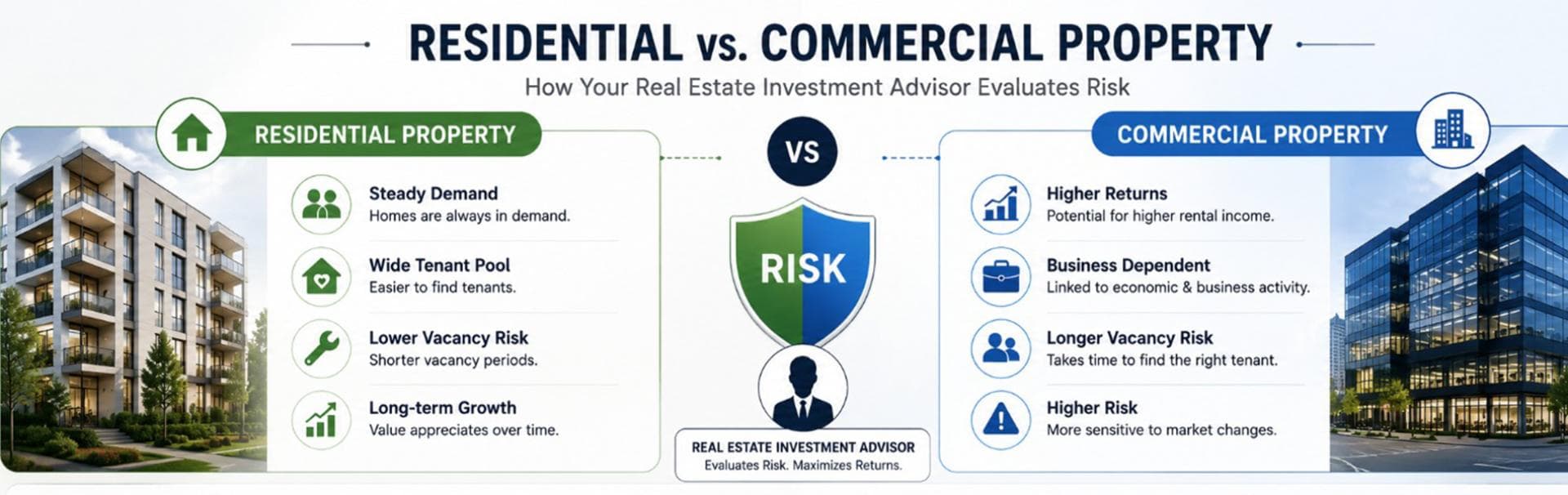
Real estate is often seen as a long-term investment, but not every property carries the same level of risk. Residential and commercial properties work differently, have different types of tenants, and can offer different income and growth opportunities.
If you are deciding between buying a house or apartment and investing in an office, shop, or other commercial property, understanding the risks is important.
This is where a Real Estate Investment Advisor can help. Instead of looking only at the expected returns, an advisor looks at what could go wrong and whether the potential return justifies the risk.
Let's understand how residential and commercial properties compare and how an advisor evaluates them.
What Is Residential Property Investment?
Residential property includes apartments, flats, independent houses, villas, and other properties meant primarily for people to live in.
Many investors choose residential property because there is generally a broad pool of potential tenants. People need homes regardless of their profession or business activity. Residential properties can provide rental income and may also appreciate in value over time.
However, they are not completely risk-free. Rental income can be affected by vacancy, maintenance costs, changing tenant demand, and local property prices.
What Is Commercial Property Investment?
Commercial property includes office spaces, retail shops, warehouses, industrial spaces, and other properties used for business purposes.
Commercial properties can potentially provide attractive rental income, particularly when located in established business or retail areas.
However, commercial investments can also involve higher risks. Finding a suitable tenant may take longer, and the property may remain vacant for an extended period if demand is weak. The performance of a commercial property can also be closely linked to economic conditions and business activity.
How a Real Estate Investment Advisor Looks at Risk
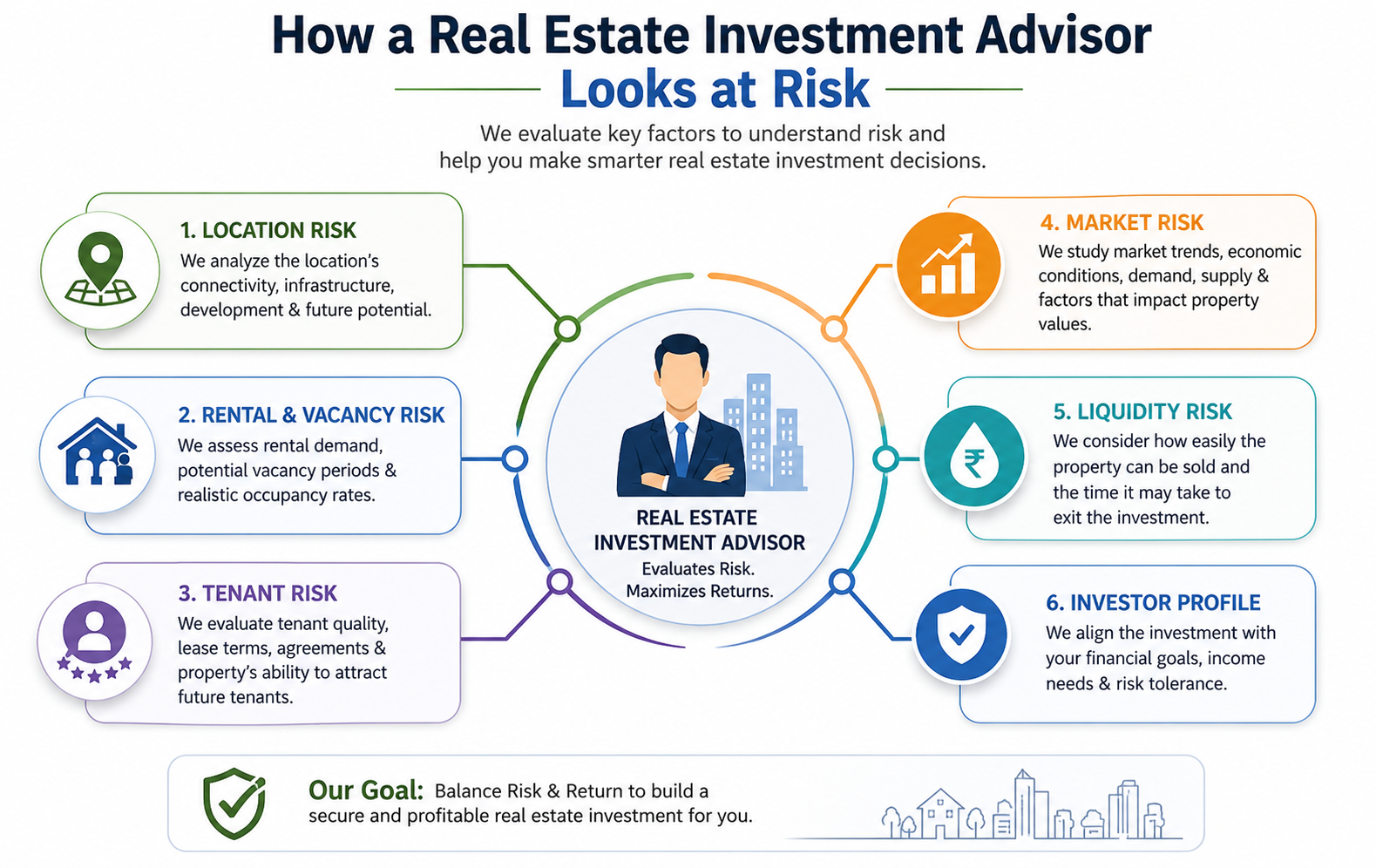
A Real Estate Investment Advisor does not simply compare the expected rental income from two properties.
Instead, they may look at several factors that can affect the investment over time. The first is the investor's own financial situation. Someone who depends on rental income to meet monthly expenses may need a different property strategy from someone who can hold a property for 10 years without needing regular income.
Understanding your financial goals is therefore the first step in evaluating risk.
Location Risk
Location is one of the biggest factors in real estate.
For residential properties, an advisor may look at schools, hospitals, transportation, shopping areas, employment centres, neighbourhood development, and overall liveability.
For commercial properties, factors such as business activity, customer footfall, office demand, connectivity, parking, and nearby commercial developments may be more important.
A property in a good location can still carry risks, but a weak location can make both rental income and resale more difficult.
A real estate advisor will therefore look at the property's surroundings instead of evaluating the building alone.
Rental and Vacancy Risk
Rental income is one of the biggest reasons investors consider real estate. But rent is not guaranteed.
A residential property can remain vacant when tenants move out, while a commercial property can sometimes take even longer to find a suitable tenant.
Commercial properties may also depend heavily on the type of tenant. For example, an office space in an area with low business demand may struggle to attract companies.
A property investment advisor will usually consider realistic occupancy rather than assuming the property will always remain rented.
Tenant Risk
The type of tenant can also affect your investment.
Residential properties usually have individual tenants or families. Commercial properties may have businesses with longer lease periods and more specific requirements.
A commercial tenant leaving the property can sometimes result in a longer vacancy period because the next tenant may require changes to the space.
An advisor may therefore examine the quality of existing tenants, lease terms, rental agreements, and the property's ability to attract future tenants.
Market Risk
Property markets can change over time.
Prices may increase when demand is strong, but they can also remain stable or decline when market conditions change.
Residential property is influenced by factors such as household income, population growth, interest rates, housing demand, and local development.
Commercial property is influenced by business growth, employment levels, consumer activity, office demand, and economic conditions.
A Real Estate Investment Advisor considers these factors when assessing how much market risk an investor can comfortably take.
Liquidity Risk
Real estate is not as easy to sell as stocks or other financial assets.
Selling a property can take weeks or months, depending on its location, price, condition, and demand.
Commercial properties can sometimes have a smaller pool of buyers because of their higher investment size and specialised nature.
Residential properties may have a wider buyer base, particularly in areas with strong housing demand.
An advisor will consider your investment timeline and ask an important question: Can you afford to keep your money invested if you cannot sell the property quickly? Maintenance and Operating Costs Costs don't stop after buying the property. Residential properties may require repairs, maintenance, society charges, property taxes, and other expenses. Commercial properties can also have maintenance, property management, insurance, taxes, and other operating costs. Some commercial properties may have higher maintenance requirements because of larger spaces or specialised facilities. These expenses should be considered when calculating your actual return. Financing Risk Many property investors use home loans or commercial property loans to finance their investments. Borrowing can help you purchase a more valuable property, but it also increases your financial responsibility. If rental income is lower than expected or the property remains vacant, you may still have loan repayments to make. A property investment advisor can help you understand how your expected rental income compares with your loan obligations and other expenses. However, investors should also consult a qualified financial professional for personalised financing advice. Which Has Lower Risk: Residential or Commercial? There is no universal answer. Residential property may be easier to understand and can have a broader tenant and buyer base. This may make it suitable for investors who prefer a simpler investment. Commercial property can potentially offer stronger rental income, but it may also come with higher vacancy, tenant, and market risks. The actual risk depends heavily on the specific property. A well-located commercial property with a strong tenant can potentially be less risky than a poorly located residential property. Similarly, a residential property in a high-demand neighbourhood may be a more stable investment than an office space in an oversupplied commercial area. How an Advisor Matches Risk With Your Goals A good Real Estate Investment Advisor does not recommend a property simply because it has a high expected return. Instead, they try to understand how much risk you can handle. For example, if you want stable rental income and have a low tolerance for vacancy, an advisor may focus on properties with established rental demand. If you have a longer investment horizon and can handle more uncertainty, you may consider residential projects in developing areas with potential for future appreciation, such as 3 & 4 BHK apartments in Sector 22D on the Yamuna Expressway. Don't Ignore Due Diligence. Regardless of whether you choose residential or commercial property, proper due diligence is essential. Before investing, check ownership and title documents, approvals, applicable registrations, developer or seller background, property condition, existing loans or encumbrances, taxes, maintenance obligations, and other relevant paperwork. For commercial property, also pay close attention to lease agreements, tenant details, rental history, and vacancy levels. A real estate advisor can help you identify important areas to investigate, but legal documents should be reviewed by a qualified property lawyer where appropriate. Final Thoughts Residential and commercial properties can both play a role in a real estate investment portfolio, but they come with different risks. Residential properties may offer a broader tenant base and simpler management, while commercial properties may offer attractive rental opportunities but can involve greater vacancy and tenant-related risks. The right choice depends on your budget, financial goals, investment horizon, expected income, and risk tolerance. An experienced Real Estate Investment Advisor can help you look beyond the advertised returns and evaluate what could affect your investment over time. Remember, there is no completely risk-free property investment. The goal is not to eliminate every risk but to understand the risks before investing and choose an opportunity that fits your overall financial plan. Frequently Asked Questions
1. Is residential property less risky than commercial property?
Not always. Residential property may have a broader tenant base, but the risk depends on factors such as location, demand, price, vacancy, and property condition. A good commercial property can sometimes be more stable than a poorly located residential property.
2. Which gives better rental income, residential or commercial property?
Commercial properties can sometimes offer higher rental yields, but they may also have higher vacancy and operating risks. Rental returns vary significantly depending on the property and location.
3. What is the biggest risk in commercial property investment?
Vacancy and tenant risk can be significant. If a commercial property remains vacant for a long period, the investor may have to manage property-related expenses without receiving rental income.
4. What are the main risks of residential property investment?
Common risks include vacancy, maintenance expenses, changing rental demand, property price fluctuations, and difficulty selling quickly.
5. How does location affect property investment risk?
Location affects demand, rental potential, resale value, and future development. A property in an area with strong connectivity and demand may have a different risk profile from one in an area with limited development.
6. What does a Real Estate Investment Advisor do?
A Real Estate Investment Advisor evaluates property opportunities based on factors such as investment goals, budget, rental potential, market conditions, property risks, and expected holding period.

The residential Real Estate Buyer...Read more

Kalpataru Vista is a new premium...Read more

Change your lifestyle, change Your...Read more

Jewar Airport is an Noida International...Read more

Noida has become one of...Read more

Gurgaon‘s Golf Course...Read more


Connecting the corners of the...Read more

It's that time of the...Read more

Metaverse real estate is one...Read more

Are you looking for ways...Read more

Budget 2023 - The projects...Read more

The process of buying and...Read more

The Delhi–Mumbai Expressway is a 1,386 km...Read more

The commercial real estate sector...Read more

The Uttar Pradesh cricket association...Read more

Nestled in the lush greenery...Read more


Introduction

The Read more

Noida has rapidly become one...Read more

Noida’s real estate market has...Read more

Noida is no...Read more

The Read more


Noida...Read more

Read more




Read more




A...Read more





Read more





Read more




Read more


Read more


Read more



Read more



Read more

Read more


Noida...Read more





Read more






Read more


Find your dream property with trust, quality, and the
perfect match for your needs.

Office Address
303, Tower 4, Assotech Business Cresterra,
Sector 135 Noida, Uttar Pradesh, India 201305

Contact
+91 9582-211-311

Email Us
info@propcasa.com